The Field Identity Problem: Why the Same Acre Has Three Different Names
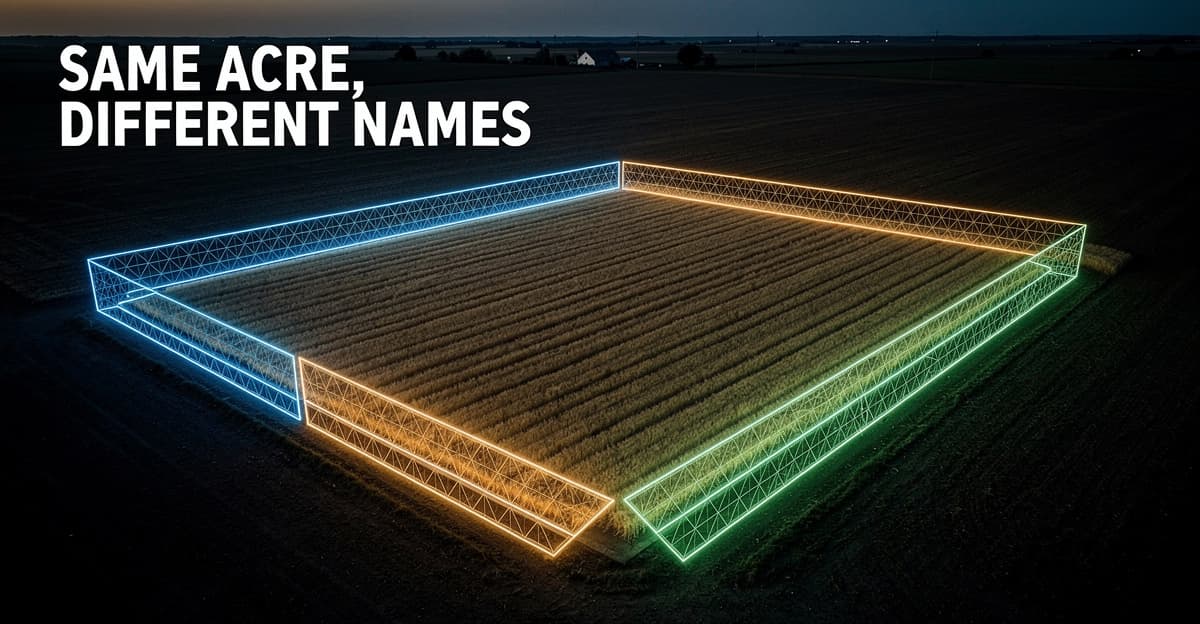
Here's a problem that doesn't show up in any marketing material but will absolutely break your application in year two: the same physical field exists as three separate records across three different platforms, with three different names, three slightly different boundary polygons, and no shared identifier between them.
This isn't a hypothetical. It's what happens when a farmer uses John Deere Operations Center for guidance and machine data, Climate FieldView for scouting, and Trimble for application records. Each platform got its boundary drawn a different way. Maybe one was drawn by hand on a tablet. Maybe another was auto-detected from machine data. The acreage doesn't match exactly. The field name is "Home 40" in one system and "Home Farm NE" in another.
If you're building anything that aggregates data across providers, this will be your problem to solve. Leaf's API takes a real swing at it. I want to explain how it actually works, and then show you where FieldMCP fits into that picture.
Why Field Boundaries Are Messier Than They Look
A field boundary is a polygon. Polygons are math. Math should be consistent.
The problem is that the polygon gets drawn by humans (or by automated detection algorithms trained on machine path data), and those processes don't agree on where a field edge is, especially on irregular ground.
Consider what happens at the corners. One operator drives to the fence line. Another doesn't. The auto-detected boundary from planter path data clips the headland differently than the hand-drawn polygon in FieldView. You end up with two polygons representing the same physical acre that overlap by 94% but are technically different geometries.
Now multiply that by the number of fields on a real operation. My uncle farms around 1,400 acres across a dozen landlords. Some fields have been in three different software systems over the past decade. The geometry drift accumulates. This is not a solved problem in precision agriculture, which is something the IEEE article on the history of precision ag doesn't fully reckon with, but it's the reality anyone building in this space runs into fast.
What Leaf Actually Does With Those Polygons
Leaf's approach is documented in their tutorial on field boundary management, but I'll give you my read on the mechanics.
Leaf takes the field geometry, the field name, and the season from each connected provider. It then runs a matching process to determine whether two records from different providers are probably the same physical field. The matching uses geometric overlap, not exact equality. Two polygons don't need to be identical. They need to overlap enough to be reasonably interpreted as the same location.
When Leaf decides they match, it creates a Merged Field. That Merged Field gets a stable ID that doesn't change when the underlying provider records change. That ID is your anchor.
This matters for a few reasons. First, you can query operations data from John Deere and yield data from FieldView and join them on a single field reference. Second, when a farmer updates their boundary in one platform, your application doesn't have to re-discover the field. Third, when you're building something that persists data about a field (recommendations, notes, historical analysis), you have a stable key to store it against.
The geometry matching isn't magic. It will miss fields that have genuinely different footprints due to boundary renegotiation or land parcel changes. But for the common case, where the same physical field got drawn slightly differently in two apps, it works.
The canonicalFieldId and How It Shows Up in FieldMCP
When you call deere_get_field_overview through FieldMCP, the response includes a canonicalFieldId when the field has been synced and matched. This is a UUID that corresponds to the merged identity across providers.
Here's the call:
{
  "orgId": "your-org-id",
  "fieldId": "deere-field-id",
  "include": ["details", "boundary", "operations"]
}
The canonicalFieldId in the response is the field's stable cross-provider identity. You can read more about the full parameter set at /docs/tools/deere/get-field-overview.
If you're building a feature that stores agronomic recommendations per field, store them against the canonicalFieldId, not the provider-native field ID. The provider ID can change. The provider might change. The canonical ID is the thing that survives both.
Here's a pattern that makes sense for cross-provider field work:
// Step 1: Discover fields in the org
{
  "resourceType": "fields",
  "orgId": "your-org-id"
}

// Step 2: Get full details including boundary and operations for a field
{
  "orgId": "your-org-id",
  "fieldId": "deere-field-id",
  "include": ["details", "boundary", "operations"],
  "operationsDateRange": {
    "startDate": "2024-01-01",
    "endDate": "2025-01-01"
  }
}

// The response includes canonicalFieldId — store this.
// Use it as your stable key when joining data from other providers.
See /docs/tools/deere/list-resources for the full options on resource discovery.
What This Actually Enables (and What It Doesn't)
When the field identity problem is solved, a class of applications becomes possible that simply wasn't viable before.
You can build a planting-to-harvest traceability view that spans providers. Planting data from John Deere, application records from Trimble, harvest from FieldView, all joined on the same field identity. You can run multi-year yield analysis without manually reconciling which records belong to which field. You can hand a canonical field ID to an agronomic analysis tool and trust that the history it sees is complete.
The thing this doesn't solve: data quality within a single provider. If a planting record in John Deere Operations Center has a wrong seeding rate because the operator didn't set the controller correctly, Leaf's field merging doesn't fix that. The record is accurate to what the machine reported. Garbage in, garbage out. Field identity normalization is a prerequisite for good analysis. It's not a substitute for clean data.
The other thing to know: the merge isn't instantaneous. Leaf syncs on a schedule. If a farmer just added a field in FieldView this morning, it may not be merged yet. Build your application to handle the case where a canonicalFieldId isn't present yet on a given field record.
Start With a Real Field, Not a Demo Account
The fastest way to see this in practice is to connect a real provider account and pull actual field data. If you have a John Deere Operations Center account with a few fields, the FieldMCP quickstart at /docs/quickstart will get you reading field records in under ten minutes.
Once you have a field with a canonicalFieldId, try querying operations across a date range using deere_search_operations:
{
  "orgId": "your-org-id",
  "operationType": "harvest",
  "dateRange": {
    "startDate": "2023-09-01",
    "endDate": "2023-12-01"
  },
  "limit": 50
}
Then look at what you get back. If you're running a multi-provider setup, check whether the same field shows up with consistent identity across providers. That's the thing to verify before you build anything on top of it.
The field identity layer is boring infrastructure. But boring infrastructure is what makes everything else possible. Get it right before you build the interesting parts on top.