What Is MCP and Why It Matters for Agricultural Data
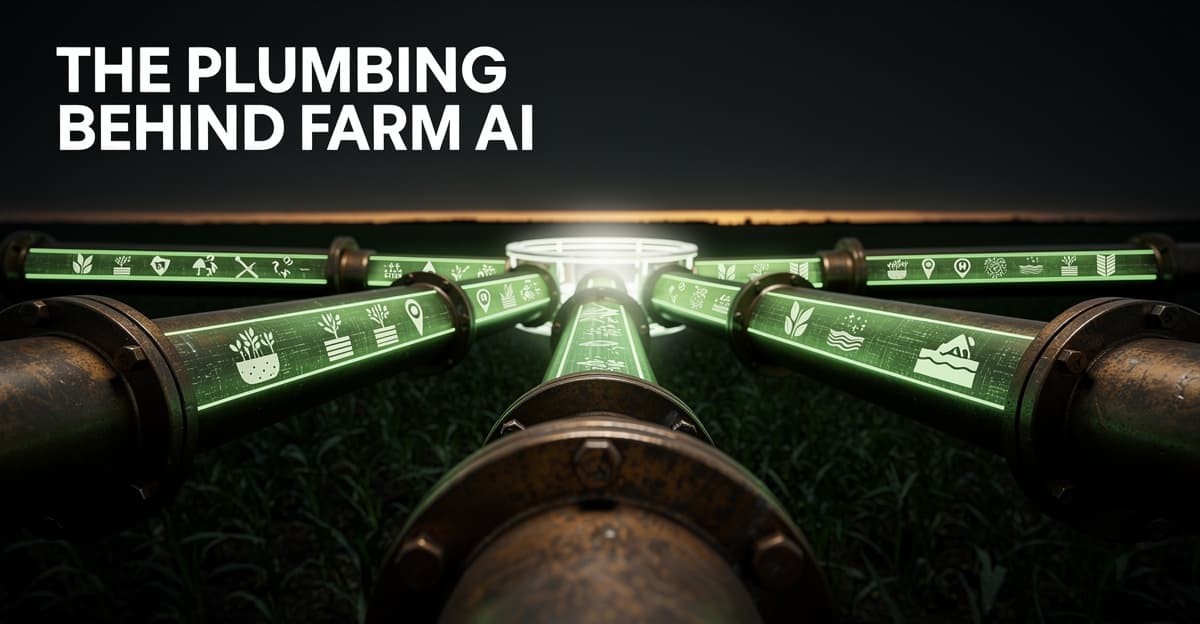
Farm data has a plumbing problem. Equipment data lives in John Deere Operations Center. Boundaries live in one system, soil tests in another, application records somewhere else. You've probably got four logins just to understand what happened on a single field last season.
LLMs can reason over farm data in genuinely useful ways. But they can't do that if they can't reach the data. MCP, the Model Context Protocol, is what fixes that. It's a standard that lets AI models call external tools in a structured, predictable way. Think of it as a universal adapter between "things an AI can ask for" and "things your systems actually know."
This isn't marketing. It's plumbing. And good plumbing is the whole game.
What MCP Actually Is
MCP is an open protocol, originally developed by Anthropic, that defines how an AI model requests information from external systems and how those systems respond. Before MCP, every team building an AI assistant on top of farm data had to invent their own function-calling conventions. The result was a mess of one-off integrations that broke when APIs changed and couldn't be reused.
With MCP, there's a shared contract. A tool has a name, a defined set of inputs, and a description the model can read. The model decides when to call it and what to pass. The server handles the actual data fetch and returns something structured.
For agricultural data specifically, this matters because the query surfaces are complex. A question like "which of my fields underperformed county average last harvest?" requires pulling field boundaries, operation records, and external yield benchmarks. That's three different calls, maybe three different APIs. MCP lets you chain those calls without writing a custom orchestration layer for every new question.
Why Agricultural Data Is Particularly Hard
Precision agriculture has been generating data since GPS auto-steer became standard in the late 1990s. (IEEE Spectrum has a good piece on that history here.) Thirty years of operational data, spread across proprietary platforms that were never designed to talk to each other.
The field boundary problem alone is nasty. Leaf's API does interesting work on this: they match field geometry across applications and assign a stable Merged Field ID so the same physical field has a consistent identifier regardless of which platform you're looking at it from (see how they handle it). That kind of canonical identity is exactly what you need before you can do anything useful with AI.
FieldMCP handles this too. When you call deere_get_field_overview, you get back a canonicalFieldId, a stable UUID that persists across syncs. That's what lets you reference the same field reliably when you're chaining tools.
There's also a security dimension worth taking seriously. Researchers have documented real vulnerabilities in major agtech platforms before, and the attack surface for farm management systems is larger than most people think. A well-designed MCP implementation keeps credentials server-side and controls exactly what data the model can access. Our OAuth documentation covers how FieldMCP handles this.
What a Real MCP Workflow Looks Like
Here's a concrete example. Say you want to review planting and harvest data for a specific field to decide whether it's a candidate for a rotation change next year.
First, discover your organization and fields:
// Step 1: list your orgs
{
  "resourceType": "organizations"
}

// Step 2: list fields in your org
{
  "resourceType": "fields",
  "orgId": "123456"
}
Then pull a full field overview, including recent operations:
{
  "orgId": "123456",
  "fieldId": "abc789",
  "include": ["details", "boundary", "operations"],
  "operationsDateRange": {
    "startDate": "2023-01-01",
    "endDate": "2025-12-31"
  }
}
That single call returns field details, the GeoJSON boundary, and recent planting/harvest/application records. See the full tool reference here.
If you want to search across all fields in the org for harvest data from last fall specifically:
{
  "orgId": "123456",
  "operationType": "harvest",
  "dateRange": {
    "startDate": "2025-09-01",
    "endDate": "2025-11-30"
  },
  "limit": 50
}
Full docs for that tool are at /docs/tools/deere/search-operations.
Once you have field and operations data back, you can pass it directly to intel_diagnose_field for agronomic analysis. The tool takes yield history, soil test results, rotation history, and more. It returns a prioritized action plan with confidence levels. No custom prompt engineering required on your end.
The Gap MCP Closes
The honest reason most "AI for agriculture" products don't work is not that the models are bad. The models are fine. The reason they don't work is that the data never reaches the model in a clean, queryable form. Someone asks "should I sidedress this field?" and the AI either hallucinates an answer or returns a generic non-answer because it has no idea what the soil test says, what was planted, or what the yield trend looks like.
MCP closes that gap. The model can call deere_get_field_overview, get the actual boundary and operations data, call intel_diagnose_field with that data, and return a recommendation grounded in the real agronomic record for that specific field. My uncle's operation in central Illinois runs about 1,800 acres across maybe 40 fields. Every one of those fields has a different drainage history, a different compaction situation, a different yield trend. Generic advice is worth nothing. Field-specific, data-grounded advice is worth a lot.
That's what structured farm data plus a real tool protocol can actually do.
Where to Start
If you're a developer building on farm data, the fastest path is the quickstart guide. It walks through authentication, your first tool call against a John Deere organization, and how to chain tools together.
If you're evaluating FieldMCP for an existing product, start with the full docs index to understand what's available across the Deere, intelligence, and weather tool namespaces.
The plumbing is there. Go build something that actually helps farmers make decisions.